XRP Isn't Hype — It's Infrastructure
Most tokens optimise for speculation. A few optimise for moving value. The case for XRP has nothing to do with price — and the honest version admits what could beat it.

Most tokens chase attention. A few are trying to be plumbing. The difference only becomes obvious when you stop looking at charts and start looking at what breaks.
In a market with thousands of cryptocurrencies, it is easy to assume they all do roughly the same thing. Most promise some combination of decentralisation, faster payments, and financial freedom.
Very few are built to solve a specific, boring, enormous problem at global scale.
XRP is one of the exceptions — and the case for it has nothing to do with price.
The problem it was built for
The global payments system is slow, expensive, and fragmented. Today, an international transfer can take three to five business days. Fees accumulate at every intermediary. Smaller banks and developing markets are frequently locked out entirely. And banks must pre-fund accounts in every currency they want to settle in, tying up capital that could be doing something else.
None of that was designed for a digital economy. It was designed for telex machines and correspondent relationships, and it has been patched ever since.
The XRP Ledger launched in 2012 to attack that specific problem, which makes it one of the oldest digital assets still in active development. If you want the mechanics — how consensus works, what On-Demand Liquidity actually does, where Ripple ends and the ledger begins — that's covered in XRP Demystified. This piece is about why the design choices matter.
Four things that actually make it different
It was built for utility, not for its own ecosystem. Most tokens are useful primarily inside the platform that issued them. XRP is designed to sit between systems — a neutral intermediary asset that lets value move between currencies without either side holding large balances of the other. That is a fundamentally different job.
Speed and cost matter at human scale. A transaction settles in roughly three to five seconds for a fee measured in fractions of a cent. A $5 remittance fee is a rounding error to a corporation. To a family sending money home every month, it is a meal. The efficiency argument isn't abstract — it lands on the people with the least margin.
It doesn't burn a power station to work. The XRPL uses consensus rather than mining. As institutions and regulators put real weight on energy disclosure, that stops being a footnote and starts being a procurement requirement.
It's designed to upgrade the system, not replace it. This is the part that costs XRP support in crypto circles and wins it in banking ones. It integrates with banks, payment providers, fintechs and central banks rather than trying to route around them. That is a less romantic pitch. It is also the only one that has ever worked for infrastructure.
Where that shows up
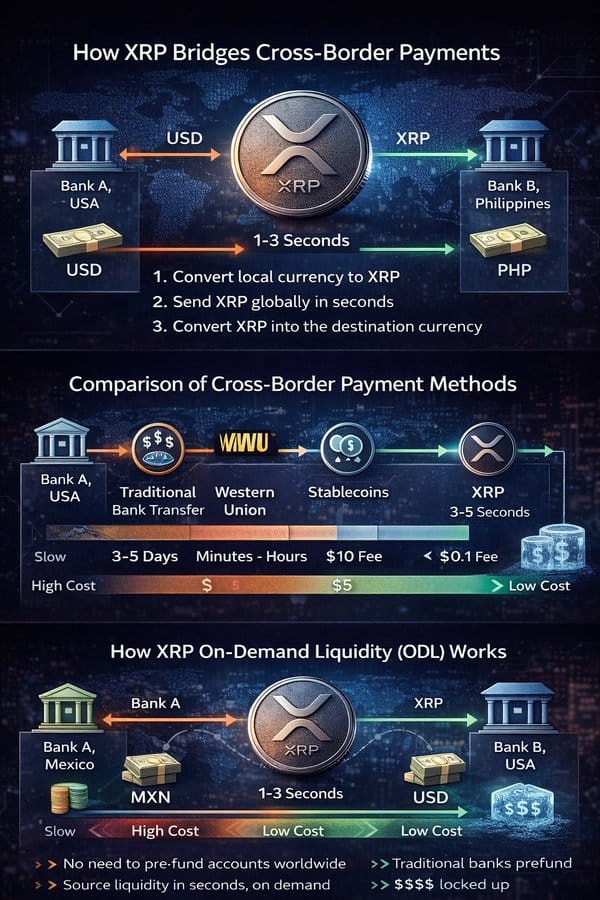
Remittances. Millions of people depend on money sent home. Lower fees, faster arrival, and access for people without a bank relationship is the most directly human use case in this industry.
Freeing up trapped capital. Pre-funded overseas accounts are dead money. Sourcing liquidity on demand releases it — which disproportionately helps smaller institutions that never had the balance sheet to play in the first place.
Tokenisation. The ledger already supports issued tokens, stablecoins and NFTs. Tokenised real estate, bonds and other real-world assets need a liquidity layer to trade against. That is a plausible role, not a settled one.
Interoperability between digital currencies. As central banks build their own digital currencies, something neutral has to connect them. A bridge asset owned by no government is one candidate among several.
Why the road has been rough
Building for integration means dealing with regulators, and XRP has taken more regulatory damage than almost any asset in the space. It has also taken sustained criticism from within crypto, where "works with banks" reads to many as a betrayal of the premise.
Infrastructure is rarely glamorous in its early years. The protocols that ended up carrying the internet looked unremarkable next to the companies burning money on top of them.
That is an argument for patience, not a guarantee. Plenty of well-designed infrastructure has lost to worse infrastructure with better distribution.
The honest version of the bet
XRP is not going to replace money. The realistic case is narrower and more useful: that global payments get fairer, that friction drops for people who feel friction most, and that capital stops sitting idle in foreign accounts.
It competes with dollar stablecoins, with central bank digital currencies, and with incumbent rails that have decades of institutional inertia behind them. Any of those could win the corridors XRP is aiming at.
But the thing worth noticing is what the project optimises for. Many networks optimise for speculation. This one optimises for movement of value. When systems come under stress, the ones that keep working are the ones that were built to work rather than built to be noticed.
That's the whole argument. Not louder. Not flashier.
Built to work.
The numbers, sourced
Settlement time — roughly 3–5 seconds. XRPL documentation; observable on-ledger.
Transaction fee — fractions of a cent. Set by the network and burned, not paid to validators.
Throughput — about 1,500 transactions per second. Project-reported capacity, not an observed sustained rate.
Launched — 2012, XRP Ledger genesis.
Network fees are not total cost. A real transfer still involves exchange spreads, on- and off-ramp fees and compliance overhead — anyone quoting you "fractions of a cent" as the all-in price is selling something.
Disclosure: I hold $FUZZY and Fuzzybear NFTs, and I distribute Fuzzycards to retailers. Nothing here is investment advice — I'm not a licensed advisor, and understanding how a technology works tells you nothing about what an asset will be worth. Everything Fuzzy is an independent community project and not affiliated with Ripple or the XRP Ledger Foundation.