Fuzzy Is the Multiplier, Not the Escape Hatch
Two beliefs circulate in every XRP-adjacent token community and they point in opposite directions. Both are wrong, and the same piece of arithmetic disposes of each.


Two beliefs circulate in every XRP-adjacent token community, and they point in
opposite directions. Both are wrong, and the same piece of arithmetic disposes of
each. What survives is a stronger argument than either.
The two beliefs
Belief one: "If XRP moons, I lose XRP by being in Fuzzy." The fear is that a
rising XRP price somehow drains the XRP out of your bag — that you will look up at
$100 XRP and find your position converts back to a fraction of what you put in.
Belief two: "Fuzzy's market cap is up, so I've made XRP." The mirror image.
The dollar chart is green, the market cap screenshot is circulating, therefore the
bag has grown.
Belief one is false. Belief two is usually false. And the reason both fail is the
same: they are quoted in the wrong unit.
The setup
Everything below uses one position, held throughout.
You hold $FUZZY worth 10,000 XRP. XRP is at $1, so the position is worth
$10,000. Fuzzy's market capitalisation is $14.3M — the figure reported as of 13
August 2026, which is a reported number and not a ledger read.
That makes your slice of the project 0.0699% of supply, or about 224 million
$FUZZY out of the fixed 320,929,807,851. Write that number down, because it is the
only thing in this article that never changes. You are not buying or selling. Your
share of the project is fixed. Everything else is a question of what that share is
measured against.
KEY CONCEPT
An AMM prices $FUZZY in XRP — it is the ratio of the two reserves in the pool.
The dollar price of XRP is an event happening outside the ledger. It does not add
or remove a single token from either reserve.
Belief one, dismantled
If XRP goes from $1 to $100 and nobody trades the Fuzzy pool, you sell your bag
back for 10,000 XRP. Exactly what you started with. Not one XRP less.
The pool holds an XRP reserve and a FUZZY reserve, and the exchange rate between
them is just those two numbers divided by each other. XRP_reserve × FUZZY_reserve = k. Nothing about XRP's dollar price touches either reserve, so the ratio you
sell back into is the ratio you bought at.
The dollar value of that unchanged bag went from $10,000 to $1,000,000. That is
real money — but it is the XRP rally, and you would have captured it identically by
holding 10,000 plain XRP and never touching Fuzzy at all.
You do not lose XRP when XRP rises. You simply do not gain any.
Belief two, dismantled
Now the same scenario read from the other end, because this is where the confusion
actually lives.
When someone says "Fuzzy's price stayed the same," they can mean two completely
different things, and the difference is the entire article.
If Fuzzy's price in XRP stayed the same — the pool untouched — then Fuzzy's
dollar market cap automatically went from $14.3M to $1.43B. A hundredfold. Screenshots
everywhere. And your bag is worth exactly the 10,000 XRP you started with. The
market cap did not rise because anyone bought Fuzzy. It rose because the ruler got
longer.
If Fuzzy's price in dollars stayed the same — market cap still $14.3M while XRP
went 100× — you have been quietly destroyed. Fuzzy's market cap measured in XRP fell
from 14.3M XRP to 143,000 XRP. Your bag is now worth 100 XRP. You held through a
99% loss and the dollar chart never moved a pixel.
THE TRAP
A flat dollar market cap during an XRP rally is not neutral. It is a catastrophic
decline, hidden by the unit it is quoted in.
What actually moves your XRP count
There is only one lever, and it is not the one most people watch:
Your XRP count = your fixed share of supply × Fuzzy's market cap measured in XRP.
Not measured in dollars. In XRP. Your bag grows when, and only when, Fuzzy's
XRP-denominated market cap grows — which is to say when there is genuine net buying
pressure into the pool, independent of whatever XRP is doing against the dollar.
Figure 1 is that sentence as a table.
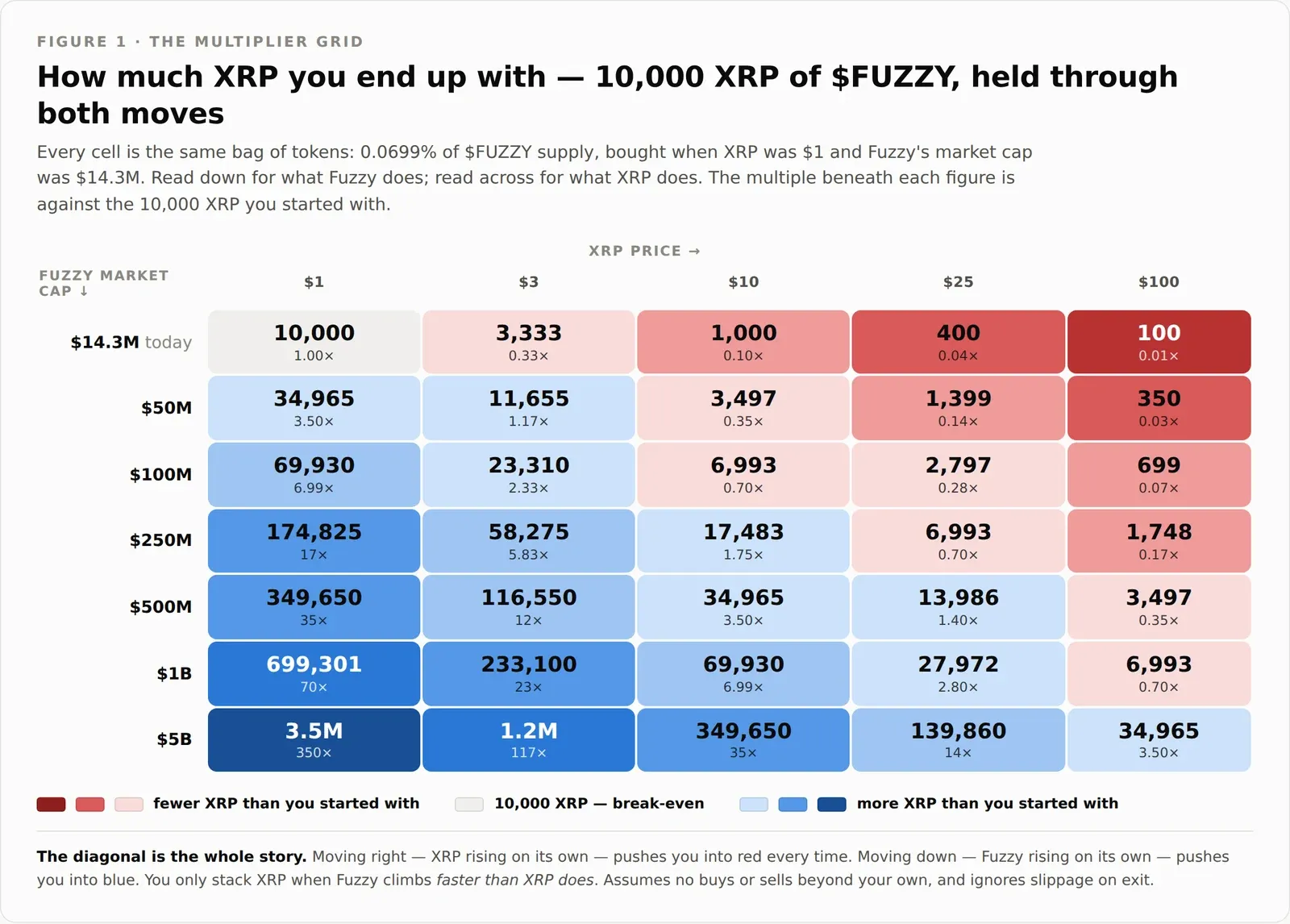
Read across for what XRP does, down for what Fuzzy does. Moving right on its own
pushes you into red every time. Moving down on its own pushes you into blue. The
only cells that pay are the ones where Fuzzy climbed faster than XRP did.
Read the XRP chart, not the dollar chart
Every token on the XRP Ledger has two charts. Same token, same ledger, same
seconds. They routinely tell opposite stories, and almost every screenshot that
circulates is the wrong one.
FUZZY/XRP is the real chart. It is the pool ratio itself — a primary quantity
that lives on the ledger. The AMM trades the pair FUZZY/XRP. When that line moves,
somebody bought or sold $FUZZY. Nothing else can move it.
FUZZY/USD is a derived chart. It is FUZZY/XRP multiplied by whatever XRP/USD
happens to be on some off-ledger exchange at that moment. It is two independent
things stapled together, and on any given day most of its movement is the half that
has nothing to do with Fuzzy.
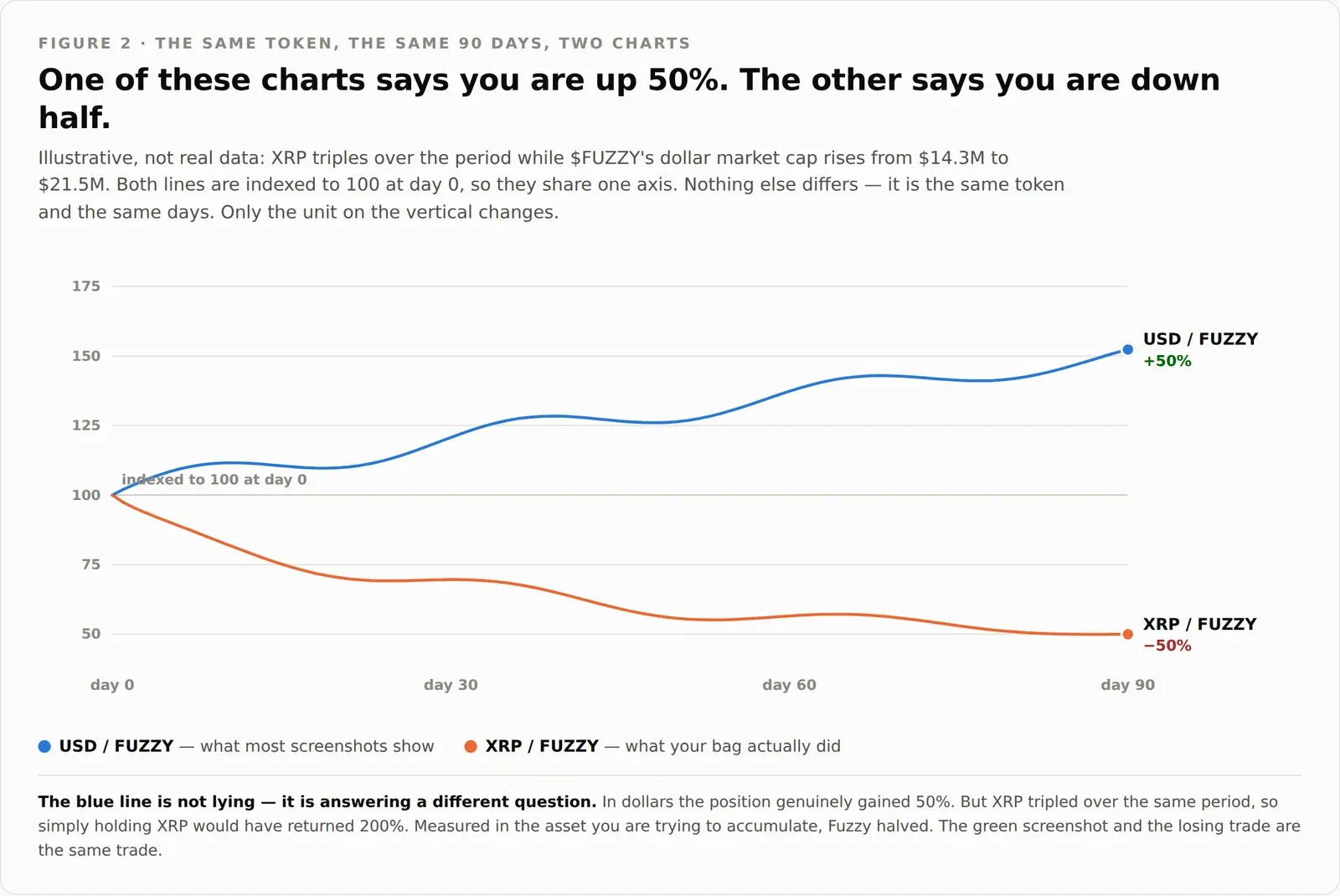
That figure is illustrative rather than real data, but the shape is not
hypothetical — it is what a rising XRP does to every token chart on the ledger
simultaneously.
Why the distinction matters
It is the only chart that tells you whether anyone is buying Fuzzy. A green
FUZZY/USD candle tells you Fuzzy went up, or XRP went up, and it will not tell
you which. A green FUZZY/XRP candle has exactly one cause: net demand for $FUZZY.
As a signal, the dollar chart has most of its information stripped out.
It is the only chart that tracks your bag. Your XRP count moves with Fuzzy's
XRP-denominated market cap and nothing else. FUZZY/XRP is your position, plotted.
FUZZY/USD is your position multiplied by a number you do not control.
It cannot be moved by something unrelated to Fuzzy. An ETF headline, a court
ruling, a macro print — all of these can send FUZZY/USD vertical while the pool sits
completely untouched. The dollar chart will hand you a rally that never happened.
It stops you setting incoherent targets. This is the practical one. "$1B market
cap" and "$100 XRP" feel like two bullish beliefs that stack. Quoted in XRP they are
visibly in conflict, and the next section works through exactly that pair. You cannot
make that mistake on an XRP-denominated chart, because the XRP price is not hiding
inside the number.
THE RULE
If your goal is to end up with more XRP, then XRP is your unit — for entries,
for targets, for profit and loss, and for the chart you look at. A dollar figure is
a translation, and translations lose things.
Where to find it
Most XRPL-native front-ends quote in XRP already, because XRP is the base currency of
the ledger's DEX — the pair genuinely is FUZZY/XRP, and the dollar figure is the one
being computed for you. xrpl.to, for instance, carries MCAP XRP
and VOL XRP columns directly. Broad crypto aggregators do the reverse: they convert
everything to USD by default, because that is the unit their audience shares.
So the habit is small. Find the denomination toggle once, set it to XRP, and leave it.
Then quote your position the same way: not "I'm up 40%," but "I'm up 40% in XRP" —
or, more often than people expect, down.
The one case where dollars are correct
If you intend to spend the money — a house, a car, a bill — then dollars are genuinely
your unit and FUZZY/USD is genuinely your chart. Nothing above is a claim that XRP is
the objectively true measure of value.
The point is narrower and harder to escape: pick the unit that matches what you are
trying to end up holding, and then use it consistently. The damage is done by
switching mid-argument — buying to stack XRP, then measuring the result in dollars,
then setting the next target back in dollars again. That is not one strategy with a
rounding error. It is three different strategies wearing the same trade.
The number nobody wants to hear
Look at the $1B row at $100 XRP. 6,993 XRP — 0.70×. You would finish with
fewer XRP than you started with.
That is not a typo, and it is not bearish. It is what happens when you hold a
dollar market-cap target and an XRP price target in your head simultaneously
without checking whether they are compatible.
At $100 XRP, Fuzzy needs a $1.43B market cap just to break even in XRP terms.
Below that hurdle, you would have been better off never buying Fuzzy at all.
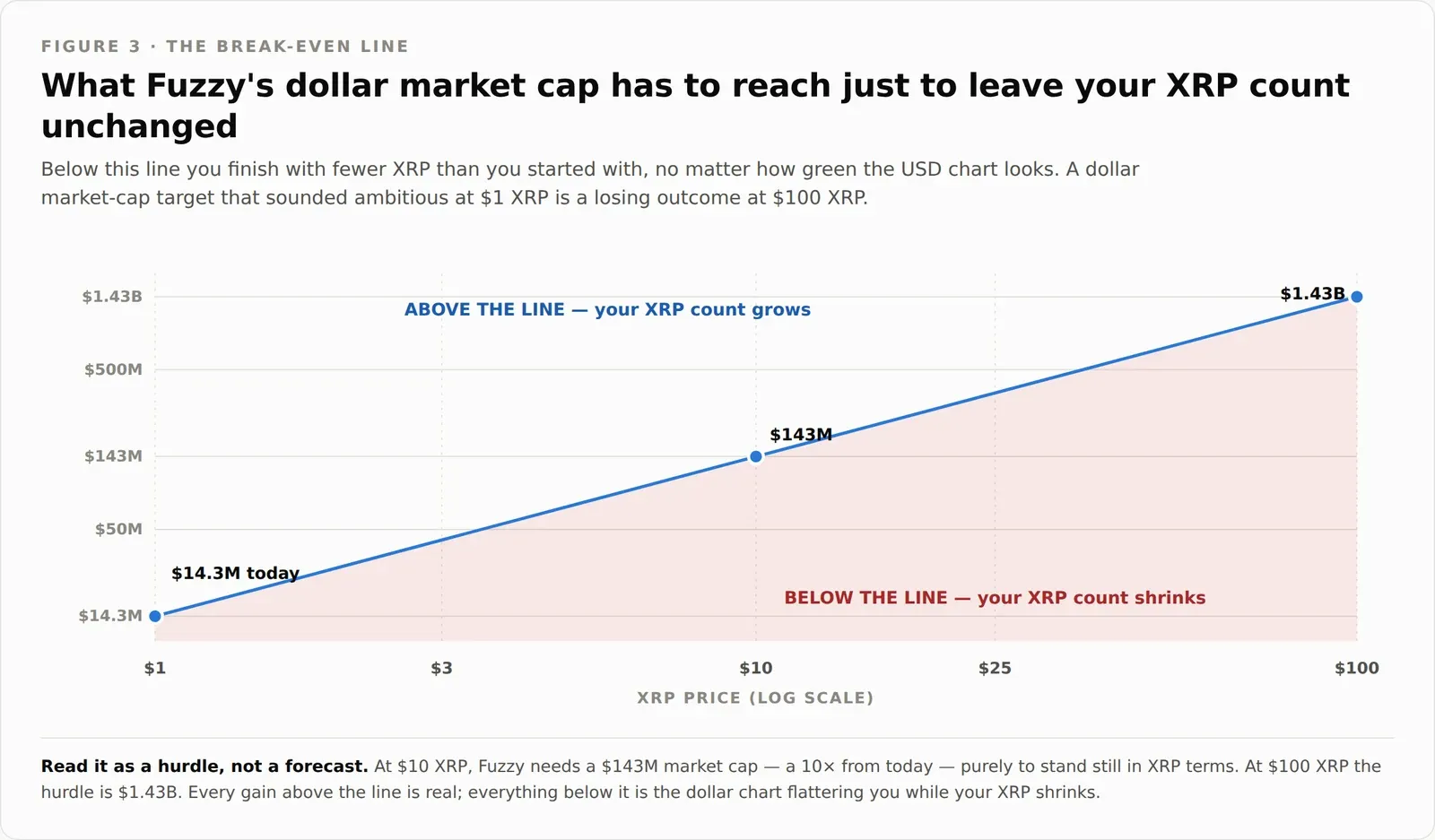
| If XRP reaches | Fuzzy must reach | just to leave your XRP unchanged |
|---|---|---|
| $1 | $14.3M | today's market cap |
| $3 | $42.9M | 3× from here |
| $10 | $143M | 10× from here |
| $25 | $357M | 25× from here |
| $100 | $1.43B | 100× from here |
The targets people quote — $100M, $500M, $1B — are dollar targets. An XRP
rally silently deflates every one of them. A $500M Fuzzy is a 35× on your XRP at
today's XRP price, a 3.5× at $10 XRP, and a 65% loss of XRP at $100 XRP. Same
market cap. Three completely different outcomes.
So where does the multiplier come in?
Here, and this is the part worth actually internalising.
Your dollar outcome decomposes cleanly into two independent moves that multiply:
Total return = XRP's move × Fuzzy's move measured in XRP
Take a case that clears the hurdle comfortably. XRP goes to $10 — a tenfold.
Fuzzy reaches a $1B market cap, which at $10 XRP is 100M XRP of market cap
against today's 14.3M, so Fuzzy is up 6.99× in XRP terms.
- Your bag: 10,000 XRP → 69,930 XRP
- Its value: $10,000 → $699,301
- Plain XRP would have returned 10×. You got 70×.
Fuzzy did not replace the XRP thesis. It multiplied it by 6.99. That is the
real argument, and it is a much better one than "Fuzzy goes up when XRP goes up,"
because it survives contact with a spreadsheet.
The best case is not XRP rising, and it is not Fuzzy rising. It is both — with
Fuzzy rising faster, because only that surplus becomes XRP in your pocket.
What could go wrong
A page that only lists the upside is not analysis, it is a pitch.
The multiplier is symmetric. If Fuzzy halves in XRP terms while XRP goes 10×,
your 10× becomes a 5×, and you underperform the plain XRP holder who did nothing.
Every cell in the top-right of Figure 1 is that outcome.
Meme coins can go to zero while the base asset moons. There is no mechanism
that couples $FUZZY's XRP-denominated ratio to XRP's dollar price. Nothing about a
fixed supply, a good origin story, or a printed card game creates buying pressure.
The $14.3M market cap is reported, not verified, and dated 13 August 2026. Every
multiple in this article is anchored to it. If the real figure differs, every
break-even number moves with it.
Slippage is ignored throughout. Selling your whole bag is itself a trade against
the pool. If your holding is 10% of the pool's FUZZY reserve you receive roughly 9.1%
less than the headline figure — and that penalty is identical at $1 XRP and at $100
XRP, because it depends on your size relative to the pool and nothing else.
Concentration is unmeasured here. A 0.0699% slice is a real position; whether the
other 99.93% is distributed or sitting in a handful of accounts changes the risk
completely, and this page does not tell you.
The one-sentence version
Price your Fuzzy position in XRP, not dollars — and look at the FUZZY/XRP chart, not
the FUZZY/USD one. A rising XRP price flatters every token on the ledger equally and
tells you nothing about which one is working; the only honest scorecard for $FUZZY is
FUZZY/XRP, and the only thing that puts more XRP in your bag is that ratio going up.
If you believe Fuzzy reaches $100M, $500M or $1B, finish the sentence: by when, and
at what XRP price? Until you attach the second half, the target does not mean anything.
Verify the arithmetic yourself
Every number above comes from two lines:
your share      = 10,000 XRP ÷ (Fuzzy market cap in USD ÷ XRP price)
your XRP later  = your share × (later market cap in USD ÷ later XRP price)
Substitute your own entry, your own targets, and your own XRP assumption. The
conclusion does not depend on the numbers chosen — it depends only on the fact that
a dollar market cap contains the XRP price inside it, and an XRP-denominated one
does not.
Read next: What $FUZZY Actually Is — the reference page
for supply, the issuer, and which claims survive checking. New to liquidity pools?
Start with Crypto, DeFi & the New Age of Earning on the
Ledger.
Disclosure: I hold $FUZZY and Fuzzybear NFTs, and I distribute Fuzzycards to
retailers and earn a commission on orders placed through me. Everything Fuzzy is an
independent community project and not an official Fuzzy channel. Nothing here is
investment advice — the figures are arithmetic under stated assumptions, not
forecasts, and no part of this page is a claim about what any asset will be worth.
Market capitalisation of $14.3M reported as of 13 August 2026; supply of
320,929,807,851 verified on the XRP Ledger. Sources: $FUZZY issuer on
XRPScan
· XRPL Automated Market
Makers.